Srbija
 Hrvatska
 Slovenija

Thousands gather to lay Srebrenica genocide victims to rest, 30 years on


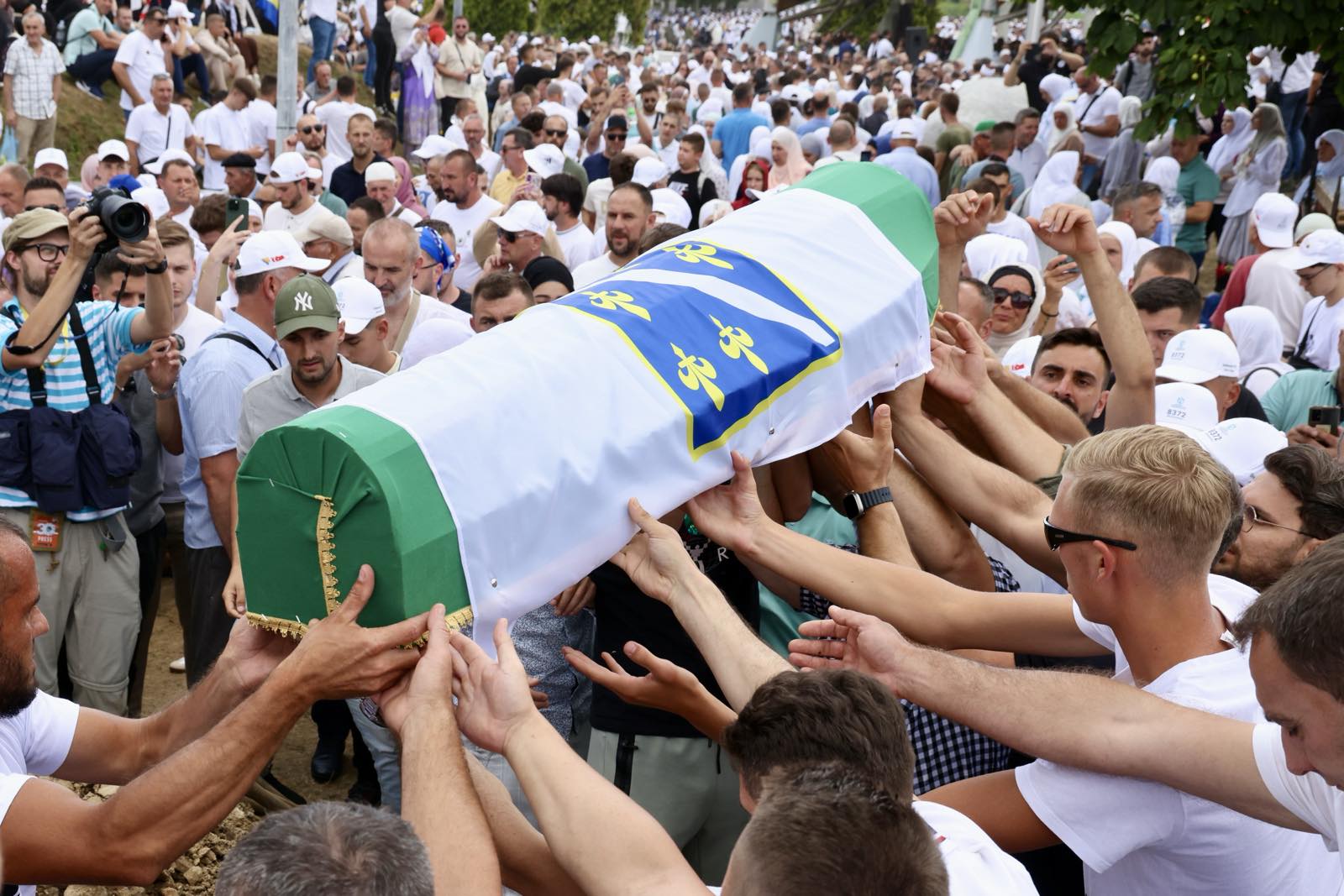
Thousands of people attended the collective funeral in Potocari, where seven more victims of the Srebrenica genocide committed in July 1995 found their final rest among the white headstones.
On the 30th anniversary of the genocide, a large number of delegations from Bosnia and Herzegovina, the region, and the world arrived in Srebrenica, joining citizens of BiH in paying final respects to the victims and expressing their solidarity with their families.


After the commemoration held at the Battery Factory, numerous officials laid flowers next to the Memorial Stone, after which the religious part of the program began at the Potocari Memorial Center with the recitation of Yasin, the ilahi “Sehidi,” and the Srebrenica Inferno performed by the “Children of Srebrenica” choir.
Sobs and painful sighs broke the silence
This was followed by a khutbah delivered by the Grand Mufti Husein ef. Kavazovic, who also led the funeral prayer attended by thousands of people, after which the burial of the remains of the seven victims of the Srebrenica genocide took place.
Among those buried today were two young men, Avdic Senajid and Mujic Hariz, both born in 1976. They were only 19 years old when they were killed. They were torn from the arms of their loved ones; their dreams, youth, and lives cut short. Their remains were found in mass graves, which had been moved to cover up the traces of the crime. After painful years of searching for them, on Friday they will finally find peace and be buried with names, dignity, and prayer.
Alongside them, Bektic Fata (born 1928) was laid to rest — this year’s oldest genocide victim to find peace in Potocari — as well as Omerovic Hasib (1961), Alic Sejdalija (1961), Gabeljic Rifet (1964), and Mujcic Amir (1964).
Heart-wrenching scenes were witnessed throughout the day in Srebrenica. Sobs and painful sighs broke the silence, and when it came time for the coffins with the victims’ remains to be lowered into their graves, the pain and grief of their loved ones broke the hearts of all present.
As in previous years, the coffins this year contain incomplete remains, so some families buried just a single bone of their loved ones. Yet, as they say, even that is enough — enough to have a grave to visit and recite the Fatiha prayer.
Search continues for more than 7,500 victims
According to the Institute for Missing Persons of BiH, the victims of the genocide have been found in 87 mass graves and nearly 1,000 shared or individual graves. There are a total of 44 primary mass graves, about 30 of which were excavated on the orders of the Hague Tribunal. Bodies were then moved to 39 secondary locations to conceal the traces of the crime, while three surface mass graves and one pit were also identified.
Institute spokesperson Emza Fazlic said that more than 7,581 people are still being searched for, of which around 1,000 are missing in connection with Srebrenica.
So far, 6,765 victims have been buried at the Potocari Memorial Center, while another 250 have been buried in local cemeteries according to families’ wishes.
According to verdicts by international and domestic courts, more than 7,000 Bosniaks were imprisoned and killed in the Srebrenica genocide. The first major massacre occurred in Kravica, followed by killings in Rocevic, Kozluk, Pilica, and Branjevo.
After the executions, members of the Zvornik Brigade of the Army of the Republika Srpska (VRS), according to Hague Tribunal verdicts, participated in the operation to move the bodies — an organized attempt to cover up the genocide, which lasted from August to November 1995.
Today, many of these mass graves remain unmarked.
Kakvo je tvoje mišljenje o ovome?
Učestvuj u diskusiji ili pročitaj komentare


Kakvo je tvoje mišljenje o ovome?
Učestvuj u diskusiji ili pročitaj komentare